
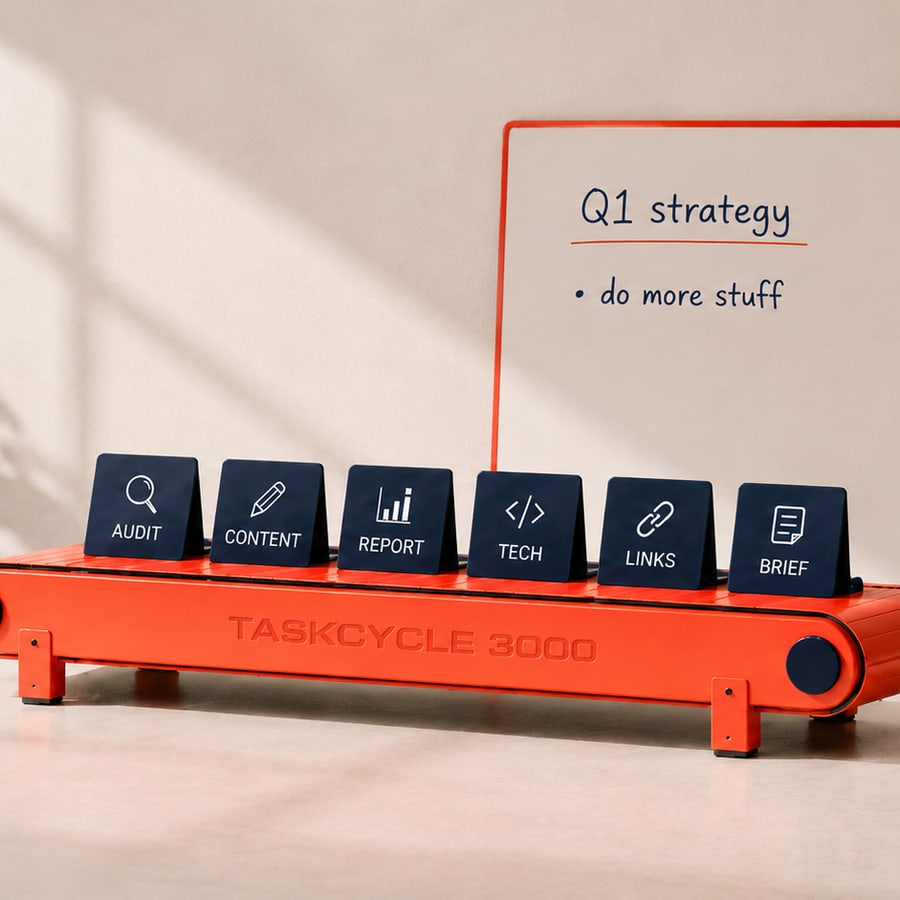
Stop Mistaking SEO Activity for Strategy
Repeatable SEO workflows are useful, but they need commercial context if they are going to drive better results.
Most SEO programmes have no shortage of things to improve.
There are title tags to rewrite, pages to refresh, internal links to add, technical issues to fix, schema opportunities to review, category pages to improve, old articles to update and new content ideas to brief.
So SEO can easily become a rolling programme of “optimise everything”.
SEO activity can feel productive. Work is being delivered. Reports are being filled. Roadmaps are moving. Everyone can point to activity.
The problem is that activity can start to replace judgement. Businesses can spend months on SEO and still struggle to explain what changed commercially. When too many unrelated tasks are happening at once, it becomes harder to see what mattered, what the business learned and what should happen next.
Optimisation needs commercial context. Without it, the work can drift into a list of improvements with no clear connection to what the business is trying to change.
Repeatable SEO workflows are useful. They help teams stay consistent, spot common problems and keep delivery moving. But they should support strategy. They should not become the strategy.
The problem with “optimise everything” SEO
Most “optimise everything” SEO starts with good intent.
A site may have weak metadata, thin category copy, messy internal links, poor templates, old content, crawl waste or technical issues that have been left alone for too long. Fixing those things can be valuable.
The trouble starts when the same improvement logic is applied everywhere at once.
If every category page needs new copy, every article needs refreshing, every technical issue needs fixing and every internal link opportunity needs action, the business is left with a full SEO programme but very little sense of where the value is coming from.
The scattergun approach creates a measurement problem. If 40 changes are made across 10 site sections in the same period, what actually moved performance?
Was it the title tags? The copy? The internal links? A merchandising change? Seasonality? A competitor dropping back? A technical fix? A campaign running elsewhere?
You will rarely isolate everything perfectly. SEO is messy by nature. But a programme that treats all optimisation as one big pile makes learning harder than it needs to be.
With “optimise everything” SEO, useful work can still leave value hard to prove.
Activity and progress are different
SEO reports can make activity look reassuring.
Forty title tags rewritten. Twelve articles refreshed. Three hundred internal links added. A technical audit completed. Category copy updated. New briefs delivered. Schema recommendations supplied.
Completed SEO tasks may all be useful. But a client still needs to know what the work was meant to change.
Which commercial problem did it solve? Which customer journey did it improve? Which pages were expected to benefit? What was the baseline? What changed after implementation? What should the business do differently next time?
Completing an SEO task does not automatically mean the business problem has been solved.
The difference between activity and progress matters because many businesses do not struggle from a lack of SEO activity. They struggle because the activity is too disconnected from prioritisation, implementation and commercial review.
The same delivery problem sits behind why SEO recommendations get stuck. SEO recommendations stall when advice never becomes work the business can prioritise and deliver. SEO work can also move forward and still fail to teach the business anything useful if it has no clear commercial frame.
Tactical output needs strategic input
Tactical SEO asks: what can we optimise?
Strategic SEO asks a different set of questions:
- Which business problem are we trying to solve?
- Which page set or site section matters most?
- Which customer are we trying to help?
- Is the problem visibility, relevance, trust, conversion or implementation?
- What can the business realistically change?
- How will we know if the work helped?
Those strategic questions should shape the tactical work.
For example, “add internal links” is a task. It may be valid, but it is still only a task.
A more useful version would define which commercial pages need more support, why those pages matter, which existing pages can pass relevant context, what anchor text or wording should be used, where the links should sit, who will implement them and when the impact should be reviewed.
That version turns internal linking into a more useful piece of work. The visible output may still be internal links, but the thinking behind it is stronger.
Why SEO workflows can take over
Agencies and internal teams need repeatable workflows.
Teams need consistent ways to onboard clients, audit sites, train people, manage capacity, review quality and keep work moving across different accounts or business units.
Repeatable workflows are also useful for spotting common issues. Metadata checks, technical audits, content refresh processes, internal linking reviews, schema checks, keyword research and reporting templates all have a place.
The problem starts when the workflow decides the work.
Workflow-led SEO can take over quietly. A client joins. The standard audit is run. The standard content gap analysis follows. The usual metadata review appears. Blog briefs are added. A monthly recommendations tab grows. It becomes the same old playbook: more audits, more content, more keywords, more links, without enough thought about whether the work is solving the right problem.
That work may be technically valid and still miss the real problem. It may focus on pages that do not matter commercially. It may create recommendations the client cannot implement. It may improve traffic that does not help the business. It may ignore the customer journey because the workflow was built around SEO checks rather than buying behaviour.
The problem sits with the delivery model, rather than with junior SEOs. Junior and mid-level SEOs are often taught how to complete a deliverable before they are given enough exposure to the commercial context behind it. The system teaches output first and judgement later.
A repeatable workflow should make good thinking easier. It should not flatten every client into the same sequence of tasks.
Different site sections have different jobs
One of the biggest problems with generic workflows is that they can treat similar page types as if they all have the same job.
Similar page types rarely have identical commercial jobs.
On an ecommerce site, a broad category page may help customers compare product types. A long-tail category page may serve a specific use case. A gift page may help someone who does not know the product category well. A product page may need to reduce uncertainty before purchase. A guide may help someone understand the problem before they are ready to buy.
Those pages should not all be judged in the same way.
A broad category page may need stronger product curation, clearer buying guidance and better links into subcategories. A product page may need better specifications, delivery clarity, reviews and reassurance. A guide may need better pathways into commercial pages rather than a hard sell.
The same applies outside ecommerce.
A SaaS comparison page, pricing page, template page, problem-led article and feature page all support different decisions. Treating them as generic “SEO pages” misses the point.
Different site sections often serve different versions of the customer. A strategic SEO process should recognise that before deciding what to optimise.
Focused SEO workstreams connect tasks to commercial problems
A focused SEO workstream gives tactical work a clearer commercial shape.
An SEO workstream groups related activity around a defined commercial problem, page set and customer context. It is more than a bucket of tasks. It is a way of saying: this is the part of the site we are working on, this is why it matters, this is what we believe is holding it back and this is how we will review the work.
A useful SEO workstream should usually define:
- The site section or page set.
- The commercial role of those pages.
- The customer context.
- The current problem.
- The SEO hypothesis.
- The tactical actions required.
- The implementation dependencies.
- The baseline.
- The success metrics.
- The review point.
- The learning to carry forward.
An SEO workstream might sound heavier than a normal task list, but it often makes delivery simpler. The work is easier to explain. The priorities are clearer. The implementation route is more realistic. The review has something specific to measure.
The point is to optimise with more intent.
A practical ecommerce example
Imagine an ecommerce retailer with 50 category pages.
A generic workflow might say:
- Rewrite all title tags.
- Add category copy.
- Add FAQs.
- Improve internal links.
- Review schema.
- Refresh metadata.
- Report on traffic next month.
Some of that work may be useful. But it does not answer the bigger questions.
Which pages matter most? Which customers are those pages for? Is copy really the constraint? Are the products relevant enough? Are users clicking through to products? Are the pages ranking but failing to convert? Are they targeting the right intent?
A strategic workstream would be tighter.
This is the difference between a metadata task and a category performance workstream.
Workstream: priority category page improvement.
Page set: 15 commercially important category pages with existing visibility and revenue potential.
Commercial problem: these pages attract impressions and some traffic, but click-through and organic revenue are weaker than expected.
Customer context: users are comparing product options and need help choosing quickly.
Hypothesis: the pages are too generic for the buying context. Titles, intro copy, internal links, product ordering and trust signals do not clearly match what the customer is trying to do.
Actions: update titles and meta descriptions, improve intro copy, review product curation, strengthen internal links, remove weak FAQs, add clearer buying guidance, annotate the changes and set a review date.
Measurement: rankings, click-through rate, clicks, product click-through, organic revenue, conversion rate and implementation blockers.
The strategic workstream is still SEO delivery. The difference is that the work has a commercial reason, a defined page set and a way to learn from the result.
Measurement should be designed before the work starts
Measurement is often treated as something that happens after implementation. In practice, it needs to be built in before the work starts.
Before a workstream begins, the business should know which pages are included, why they were chosen, what the baseline is, which metrics matter, what implementation date should be recorded and when the work will be reviewed.
Different page types need different measures.
Priority category pages might be judged on rankings, click-through rate, organic revenue, conversion rate and product click-through. Product pages might need organic entrances, add-to-cart rate, assisted revenue and conversion rate. Resource content might be judged on qualified visits, internal clicks, assisted conversions and lead quality.
SaaS feature pages may need demo requests, assisted pipeline, sales-qualified leads and internal clicks to comparison or pricing pages. Lead generation pages may need enquiry quality, form completions, call tracking, conversion rate and the number of useful conversations created.
Useful measurement means judging each SEO workstream against the job that section of the site is meant to do.
Wrap-ups turn delivery into learning
Many SEO programmes have audits, roadmaps, reports and recommendations. Fewer have proper workstream wrap-ups.
Skipping the workstream wrap-up is a missed opportunity.
A useful wrap-up should answer:
- What was planned?
- What was delivered?
- What changed during implementation?
- What was delayed or blocked?
- What results were seen?
- What did not work as expected?
- What did we learn about the site?
- What did we learn about the customer?
- What did we learn about the client’s internal process?
- What should happen next?
A workstream wrap-up gives the client a clearer view of value. It also makes future SEO work better.
If copy production took longer than expected, that should shape the next content-led workstream. If development resource was limited, the next technical workstream should be sequenced differently. If certain page types responded better than others, the next phase should use that learning.
SEO reporting should explain what happened and what the business learned.
Commercial SEO has to fit what the business can deliver
Commercially useful SEO has to consider implementation reality as well as theoretical opportunity.
The biggest SEO opportunity will not always be the best next move. Sometimes the better choice is the highest-value opportunity with the clearest route to implementation. Deciding which opportunities deserve that attention is its own discipline, one I cover in Stop Prioritising SEO Work by Search Volume Alone.
Implementation reality includes development resource, copy capacity, merchandising input, platform limitations, analytics confidence, approval processes, seasonality, stakeholder buy-in, commercial priorities, customer value and product availability.
A recommendation that never gets implemented has no commercial value, no matter how technically correct it is.
Repeatable SEO workflows have the same limitation. A workflow that produces tasks the business cannot act on falls short of strategy. It becomes organised noise.
Workflows should support judgement
SEO workflows still have a place.
Without them, delivery becomes inconsistent. Teams miss basics. Good habits depend too much on individual memory. Useful checks get skipped. Repeatable processes have real value.
But the workflow should never be where the thinking stops.
SEO creates value when tactical work is connected to a clear commercial problem, a defined customer context and a measurable outcome. That is what turns optimisation from a list of tasks into a useful business function. The same connecting logic applies to brand authority: it only pays off when it reaches the pages that convert, which I cover in Why Brand Authority Rarely Reaches the Pipeline.
For established SMEs, the opportunity is often not to do more SEO work. It is to give the right work a clearer shape.
Focused workstreams give SEO that clearer shape. They make SEO easier to prioritise, easier to explain, easier to implement and easier to review. Activity is easy to report. Strategic progress is easier to act on.
Too much SEO activity, not enough commercial progress?
I help established SMEs turn scattered SEO tasks into focused workstreams, with clearer priorities, ownership, implementation routes and review points.