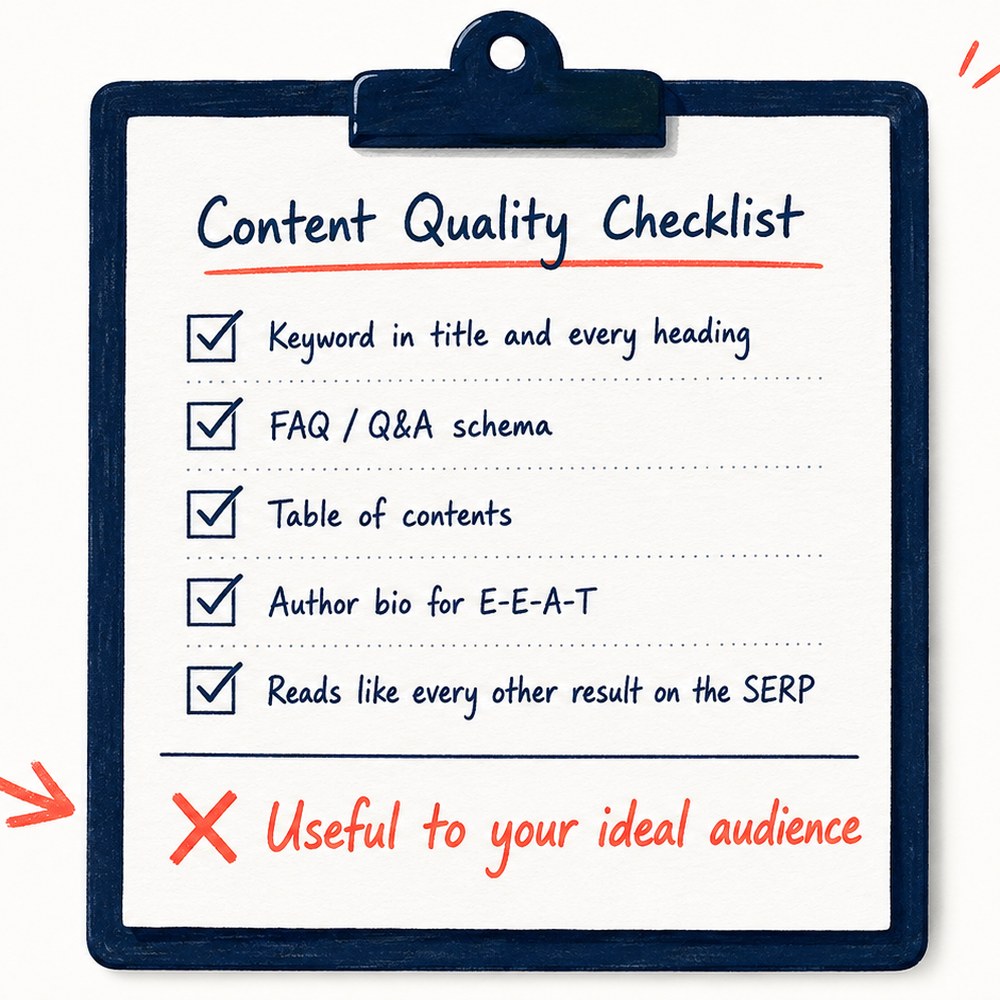
What Quality Content Actually Means
None of it is objective. Quality is whatever satisfies the one reader you're actually for.
I’ve lost count of how many times I heard “write for people, not search engines” in agency meetings. I said it myself. And I sat on both sides of the table: nodding along to it, then signing off content plans built entirely from a keyword tool.
That’s the part I know from the inside. I’d say write for people, then ship the opposite. Recommendations led by search volume. Outlines assembled from People Also Ask. Every article opening with “What is X?” and “Why is X important?” whether or not a single real reader needed either. I said write for people, then wrote for the tool, because the tool gave me numbers and the people didn’t.
What is quality content, and what does “quality” actually mean?
If you want the version an AI Overview would lift: quality content is content that satisfies the reason someone searched, accurately and clearly, and better than the next result. That’s true, and I’d stand behind it.
It’s also close to useless, because every word is doing subjective work. Satisfies whom? Better for which reader? Relevant to what they were trying to do? Take the specific person out of that sentence and there’s nothing left to act on.
What makes content “high quality” is the reader
Relevance, intent, helpfulness, quality: the four things Google keeps saying it rewards. They have one thing in common. None of them is objective. There’s no threshold where a page becomes high quality. When the Content Marketing Institute asked more than 35 experts to define what “quality” means in content, it got 35 different answers. Where they converged is what matters: almost none defined it by the content’s attributes. They defined it by the audience. That is not something you can write into a spec.
These are judgements, and the person making the judgement isn’t Google. It’s the reader.
Quality is set by the reader, not by the writer and not by the algorithm. Change who is reading, and you change what good looks like.
A page that lands perfectly for one searcher misses completely for another typing the same keyword with a different job to do.
Take E-E-A-T. It gets talked about like something you sprinkle on a page: add an author bio, bolt on a few keyword-led FAQs, done. It isn’t automatic. Experience, expertise, authority and the trust they build are subjective to you, to what you’ve done and what you know. You can demonstrate or imply them in plenty of ways, from being a brand people already recognise to showing real first-hand experience or offering an insight nobody else has. None of them is a widget you install. It’s the same trap as “quality” itself: a signal the reader can feel, not a box you can tick.
So “write for people” leaves a vacuum where the decision should be. And something easier to defend fills it.
Why keyword tools win and quality content loses
Here’s the mechanism, and I watched it play out in room after room. Volume, difficulty, PAA, related questions: these are numbers. You can paste them into a deck. You can defend them to a client. When the goal (“be useful to a real person”) is subjective and the proxy (“this keyword has 2,400 searches”) is a hard figure, the team optimises the proxy and everyone tells themselves they’re doing the goal.
This is the wider marketing trap, not just an SEO one. Once every decision has to be data-driven and defensible, the things you can count crowd out the things that matter, and the person on the other end stops being a person. They become a number: a search volume, a row in a sheet. You can run an entire content operation on those numbers and never once picture the human they’re meant to stand for. The keyword tool is just the version SEOs reach for.
Even Google won’t pretend the measurement is clean. When it described how it judges search quality, its search product lead Elizabeth Tucker put it plainly: “not everything important is measurable, and not everything that is measurable is important.” The company running the algorithm still leans on human raters and blends data with judgement, because the part that matters most resists being counted. Quality resists being reduced to a number, even for the company that built the algorithm.
That’s how a page ends up built around what a scraper found rather than what a buyer is trying to decide. The tell is always the same: definitional questions promoted into top-level sections, the real problem delayed for 600 words, a piece that sounds educational but was never relevant to anyone who could act on it. It reads like it was made for people, but it was built around a keyword tool that phrases things as questions.
Search volume isn’t the enemy. It’s a useful input, once you already know who you’re for. The mistake is letting it decide who you’re for, because it can’t. Volume tells you a lot of people typed something. It tells you nothing about whether any of them are your reader. I made that case in full in Why SEO Shouldn’t Be Led by Search Volume Alone.
How to create quality content, starting with the person
“Write for people” fails because it never says which people. The version that works is narrower and harder: write for one person. Your ICP. The specific reader the business can help.
Name that person and the subjective stuff stops being vague. “Relevant” becomes relevant to an agency lead who tracks rankings fine but can’t report across fifteen clients without rebuilding dashboards every month. “Helpful” becomes whatever moves that person one step closer to a decision. Intent stops meaning “what the query literally asks” and starts meaning what that reader is trying to work out underneath it, which is rarely the same thing. Search intent is what the query appears to ask. Buyer intent is what your reader is trying to decide. PAA gives you the first. Only knowing your ICP gives you the second.
A quality content checklist built around your ICP
Search “quality content checklist” and you get the same list every time: useful, accurate, relevant, original, E-E-A-T, readable. Every one of those describes the content. You can tick all of it and still lose the reader, because none of it asks about the person on the other end.
So here’s a different one. It doesn’t ask what your content is. It asks what your ICP goes through when they land on it:
- Can they get to what they clicked for without wading through your “what is X / why X matters” filler first?
- Once they’ve read it, do they have enough to satisfy the query, or are they hitting back to find the bit you left out?
- If the next thing they need is genuinely out of scope for this page, have you got a page that takes them to that next level of detail? Or did you send them to a competitor to get it?
- Having read this page, would they want to read another one of yours?
- Did it read like someone who’s done the thing, or like a page assembled to rank for the thing?
Answer yes down that list and you’ve written something quality, for that person. Change the person and you run the list again.
A checklist that only describes the content will happily pass a page that loses the reader. The test that matters is what your ICP goes through when they land on it.
How to measure content quality without grading your own homework
The reason “write for people” survived so long as a slogan, including in every meeting I sat in, is that nobody ever had to prove they’d done it. You could claim it about any page. There was no check.
That checklist above is the check, the human version. You can run it on one page over a coffee. What you can’t easily do is run it across four hundred pages, consistently, without your own bias grading your own homework. Running that read across a whole site is a step in my Google update recovery audit: every page evaluated for quality and helpfulness, judgement applied at scale rather than a plugin score with a logo on it. Hardly anyone thinks to commission that step on its own until an update has already taken their traffic. It can, and probably should, be run as a standalone audit while things are still fine — the pages an update would punish are visible long before one arrives. One clear ecommerce version of that is a set of category pages that pass every checklist item and still feature nearly the same products as the page next to them, which I cover in Why Core Updates Hit Ecommerce Sites That Look Fine Page by Page.
So keep the line. It was always right. Just stop treating it as a value you repeat, and start treating it as a test: one with a real person on the other side, and a way to tell whether you passed.
Not sure whether your content is written for readers or for search engines?
I judge content by how well it serves the specific reader it's for, then show you what's underperforming and why. If a full audit isn't the right next step, I'll say so first.